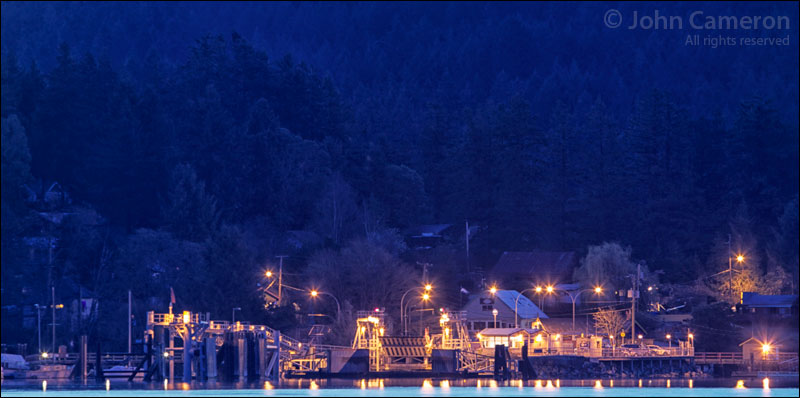
The first ferry of the day has left for Swartz Bay and it seems Fulford Village on south Salt Spring has gone back to bed.
Salt Spring Photographer John Cameron
The first ferry of the day has left for Swartz Bay and it seems Fulford Village on south Salt Spring has gone back to bed.

These Salt Spring sheep are enjoying a frosty March sunrise. Everyone’s happy on a day like this…

I came upon this odd phenomenon on the roof of the Burgoyne United Church while travelling the Fulford-Ganges superhighway on the weekend. It seems the early morning frost melted everywhere except within the chimney shadow. Strange but true, no photo editing chicanery here folks.

This Great Blue Heron was quite a surprise. Wondering what the warm directional light might be like down on the water, I made an early morning stop at a well known Salt Spring Island lake. There were some ducks enjoying the peaceful morning and the reflections were wonderful.
I had the camera set to quiet mode and the ducks didn’t seem concerned about my presence. After a few moments I turned around on the rickety dock and began to head back to the truck when I suddenly noticed the heron hiding near the water’s edge. I took a couple of photos and slipped past the bird without incident. Great moment, photographer’s favourite, and another for the series: “Turn Around”.
A note about the Great Blue Herons, and some pre turn-around photos below.
The Great Blue Heron is the largest wading bird in North America, and measures about 60 cm in height, 97–137 cm in length, and 2.1–2.5 kg in mass (Butler 1992). The wings are long and rounded, the bill is long, and the tail is short (Butler 1992). Great Blue Herons fly with deep, slow wingbeats and with their necks folded in an S-shape. Plumage is mostly a blue-grey colour and adults have a white crown. —source: BC Government
Click on the images below to enlarge:



Fernwood dock at sunrise on a calm morning. A band of fog sits above the water in Trincomali Channel.
The following letter by the Fernwood Dock Management Commission Chairperson appeared recently in the Gulf Islands Driftwood, Salt Spring’s weekly newspaper. It’s included here for interest as it describes the current management and maintenance costs of the pier and dock.
FERNWOOD DOCK IS WORTH KEEPING
The recent letter from CRD about the activation of a requisition for the preservation of Fernwood Dock has understandably caused confusion. It has nothing to do with private wharfs or docks or the Harbour Authority that administers all the other Fisheries and Oceans docks on Salt Spring.
Some background might help. When the federal department of transportation decided to divest itself of some 67 docks on the West Coast, 10 of the outer islands docks were affected, as was the Fernwood Dock. Petitions were started on Salt Spring and the outer islands to save these facilities. A working group was formed and the writer ended up as spokesman for the negotiations with DOT. As a result, $1.67 million was obtained for the outer islands where a referendum approved funding. On Salt Spring we had further delays as the First Nation on Kuper Island became involved. After a two-year delay and further DOT negotiations, we obtained $280,000 and $20,000 in repairs as compensation. Subsequently a referendum was held, which approved retention of the dock, and Bylaw 2730 was approved to establish the service. No tax funding was requested for this service.
For the last 10 years or so the Fernwood Dock Management Commission has administered this public facility at absolutely no cost to the taxpayer based on interest on the capital. We have paid for insurance, CRD overheads and minor repairs. In addition, over $125,000 of major repairs have been accomplished, not to mention countless hours of volunteer help. I make no apology for the commission members, who have done a stellar job for no recompense for a decade.
Unfortunately interest rates have tanked, and last year reserves were down to $100,000. We were then in a position where in the longer term the capital would disappear and we would have neither the money to support the dock nor to decommission it, a much more expensive proposition than might appear at first sight. Accordingly, we asked for a small requisition to allow for the accumulation of a reserve fund in anticipation of major repairs within the next 10 to 15 years. The Amendment Bylaw 3761 was adopted on April 13, 2011 to allow for a parcel tax. The original amount was reduced by 33 per cent by Salt Spring’s electoral area director Wayne McIntyre to help control the overall budget. Hence the taxpayer will be asked to pay $5.50 per year. I wish the rest of the taxes I pay would return equal value.
Why should we keep this facility? It has no commercial return as some have suggested as a reason for its destruction. There is no direct benefit either from soccer pitches, parks, trails, libraries, swimming pools, ArtSpring and any number of things that make life interesting and rewarding. If direct economic return were the criterion, all of these things would be eliminated along with the dock. God forbid we turn into a society that knows the price of everything and the value of nothing.
It is of course a heritage amenity that has existed for over 100 years, enjoyed and used by hundreds every month. It is not a moorage but a connection point for Wallace Island and Galiano Island; the only refuge point for boats in distress, or medical emergencies on the east coast of the island, both of which happen. In the event of a major earthquake it might well be the only connection to the outside world.
If a charge for each tax folio of $5.50 per year is excessive and enough people want to get rid of the dock they can of course campaign to rescind the previous referendum. I do not think most people would support destroying this amenity and it would be a great pity if they did. I hope the above information may quiet some of the concern.
—Peter Lake